
BUILDING DIVERSE GLOBAL NETWORKS
CIFAR’s global networks move ideas across borders, institutions, disciplines and sectors. By creating sustained opportunities for collaboration, CIFAR helps researchers and partners build the momentum needed to pursue questions no single country, field or institution can address alone. In 2025-2026, our active partnerships with governments, research organizations, industries and foundations totalled 77, representing 9 countries around the world. These strong relationships with like-minded, innovative organizations allow us to expand and diversify the opportunities available to our research community and invest in bold ideas with the highest potential impact.
Expanding opportunities for cross-border collaboration and impact
CIFAR’s partnership with the Swiss National Science Foundation (SNSF) continues to expand opportunities for collaboration and scientific impact across CIFAR’s programs. This past year, CIFAR held three program meetings in Switzerland, as well as a Rare Diseases Workshop and the Quantum Materials School. Those meetings are already translating into action. The partnership generated 22 Catalyst Grant applications involving CIFAR and Swiss researchers, resulting in four funded projects, highlighting how our partnership has seeded high-impact collaborations across borders.
One recently funded project examines how urban growth is reshaping customary and collective lands across Sub-Saharan Africa, South America and India. By studying how shifting land systems are creating emerging “rural metropolises” and alternative urban futures, the project aims to inform local and regional planning, mentor early-career scholars, produce a joint comparative publication and lay the groundwork for larger international grant applications.
Data-Driven solutions for a changing world
Together with the Helmholtz Information & Data Science Academy (HIDA), CIFAR co-hosted a summer school in Berlin focused on data science for climate. This collaborative learning opportunity was the result of our deepening partnership with the Helmholtz-Gemeinschaft / Helmholtz Association, intended to build on our existing collaboration and foster closer cooperation to drive innovative research. CIFAR and HIDA’s immersive summer school trained 30 graduate students and postdoctoral fellows eager to tackle global climate challenges using interdisciplinary and innovative data-driven approaches at the intersection of data science, AI, climate research and remote sensing. CIFAR speakers included Stefan Bauer (Fellow and CIFAR Azrieli Global Scholar, 2020-2022, Learning in Machines & Brains; Technical University of Munich), who discussed causality in AI, Ariel Furst (CIFAR Azrieli Global Scholar, 2022-2024, Accelerated Decarbonization; Massachusetts Institute of Technology), who spoke about data standardization for clean tech, and Ann Gregory (CIFAR Azrieli Global Scholar, 2024-2026, CIFAR MacMillan Multiscale Human; University of Calgary), who led a session on how genomics and data science can help uncover the role of viruses in climate-related processes.
Spotlight
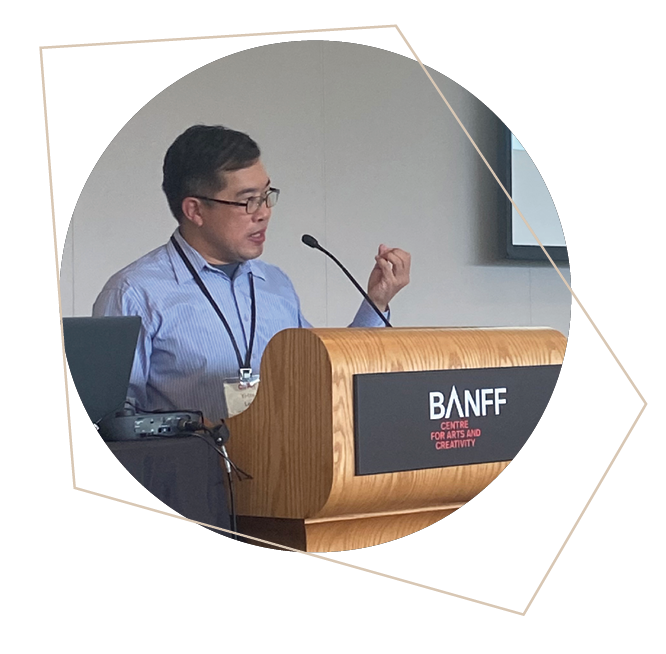
The CIFAR Canada-Taiwan Frontiers of Science Symposium marked the first joint activity between CIFAR and Taiwan’s National Science and Technology Council as part of our new partnership. Hosted in Banff, the event convened a diverse group of researchers from Taiwan and CIFAR’s research community to explore the intersection of responsible AI, democracy, governance and social trust. The event created space for early-career researchers to consider how democratic states with relatively small populations, such as Canada and Taiwan can advance technological innovation while strengthening democratic resilience. Over the course of three days, participants exemplified how meaningful interdisciplinary exchange can spark fresh perspectives and open new frontiers in research through thoughtful discussion.
Want to learn more? Explore CIFAR’s latest Impact Report.